|
| |
 Health-Care Reform In Medical Research Health-Care Reform In Medical Research
Although we are all
different and learn in different ways, I believe that the best way to
learn about medical research is to actually conduct such research.
There are
many people
who, from a very early age, pursue science as a
hobby. They love it until it is stuffed down their throats.
Granted, there is a basic fund of knowledge that
all scientists must know, but this can be learned without
'stuffing'. Even so, the essence of science remains exploration,
rather than consumption of facts. An ideal situation would be the
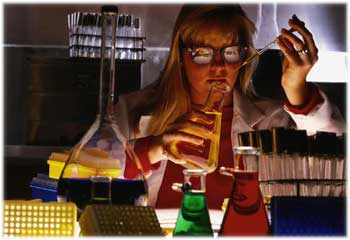
creation of community research laboratories.
The most logical place for such laboratories would be in the
schools. It has been my experience that canned textbook
experiments are unproductive as teaching tools. They are often
both tedious and quickly forgotten. If an experience is not
remembered, then real learning has not occurred.
Audiovisual
tools are an excellent way of teaching science fundamentals.
They would make learning more enjoyable for students and less
burdensome for the already overworked teachers.
Research within the schools should be facilitated by networked communication with other schools and
research facilities. Many researchers would gladly donate their
time to explain their research processes to students. Current research
would be augmented by the combined efforts of millions of students
worldwide; this could prove to be quite a powerful tool. These
students would be thrilled to know that they were actively involved in
contributing to both medical and scientific discoveries. |
|
 |
 |
Children instinctively
know what they need. As adults, our job is to
listen, observe, and make ourselves available. Our job is not, however,
to control. Those who are controlling are often mindless and
damaging to other people.
Children do not require our control, but rather, our encouragement to
explore |
| the universe and express their uniqueness.
Once we understand the needs of the individual student, we can provide
the kind of environment and the amount of structure that is most
appropriate. Our current system of educating young people is a
dehumanizing rat-race of mindless over-activity. Furthermore, it
is a waste of human potential.
One day, we will truly listen to and understand the needs of others.
We will begin striving to attain mindfulness, much as we
presently strive to attain athletic fitness. One day, mindfulness
will be a household word.
John Martin, M.D. Ph.D. operates his own
community laboratory in
Rosemead, California. Volunteers are frequently invited to visit
and participate in conducting research. Although his equipment is
mostly a surplus collection of remnants from someone else's government
grant, it is very sophisticated. Various people donate time,
money, and equipment to make it a success. A great many small
research companies are being created across the globe; many of which
welcome volunteers, much like the aforementioned laboratory.
Communication tools have
become affordable, and widely available.
There is an incredible network of people who, driven either
by a love of their subject or by the necessity of their illness, join
together in an information exchange forum to discuss a countless array
of subjects. This is real education. It is free. It
is from the heart.
Printable
Page | Back
|
Top | Next
|
Printable Site
|
|
|